Custom Fabric Is a Process, Not a Product
Brands, uniform suppliers and procurement teams that need a specific colour, weight, hand feel or performance profile eventually move from catalogue selection to custom development. The difference between a smooth development and a frustrating one is almost never the mill's capability. It is whether the process is clearly staged, with defined outputs and sign-offs at each step. This article walks through the full route from brief to bulk delivery.
Stage 1: Brief and Feasibility Review
Development starts with a written brief. The more specific it is, the fewer iterations the project needs.
A complete brief should cover:
- End use — the garment type, the wearer role and the working environment.
- Target fibre composition and, if known, the yarn count and ply.
- Weight target in grams per square metre, with an acceptable range.
- Colour requirements, ideally as a physical reference or a specified colour standard.
- Performance requirements — colourfastness, shrinkage, abrasion, functional finishes.
- Compliance requirements — any textile safety or regulatory standards that apply.
- Commercial parameters — target quantity, delivery date and price expectation.
The mill's technical team then assesses feasibility and flags conflicts. A very high yarn count combined with a very high abrasion requirement, for example, sets up a trade-off that has to be resolved early rather than discovered during testing.
Stage 2: Construction Design
With the brief agreed, the mill defines the construction: yarn specification, weave structure, density, weight and finishing route. This stage often produces two or three candidate constructions rather than one, because the trade-offs between hand feel, durability and cost are easier to evaluate side by side.
A competent technical proposal at this stage should include estimated performance ranges for each candidate, so you can see the consequences of a choice before committing to sampling.
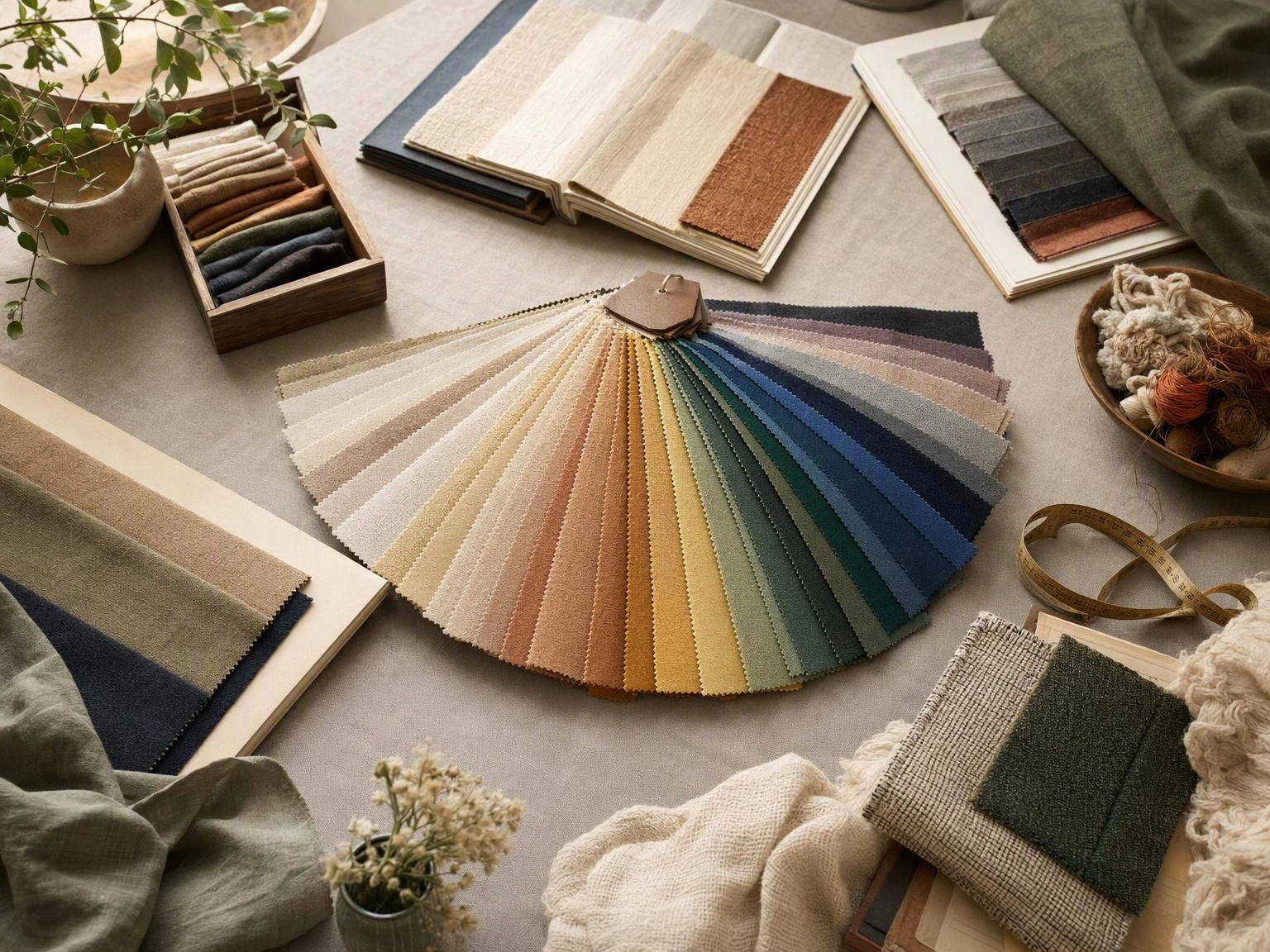
Stage 3: Colour Card Development
Where a brand colour is involved, the mill develops lab dips against the reference. This is the stage where most projects lose time if the colour brief is vague.
Practical guidance:
- Provide a physical colour reference — a Pantone chip, a fabric swatch or a previously produced garment — not only a digital value.
- Specify the light source under which the colour will be evaluated, since a dye recipe that matches under daylight may shift under retail lighting.
- Expect two to three lab dip rounds for a saturated or unusual shade, and plan the timeline accordingly.
- Approve against the actual fabric to be used, since the same dye recipe on a different construction reads differently.
- Retain the approved dip as the reference for all future production.
Stage 4: Sampling
Once construction and colour are agreed, the mill runs a sample length. Typical sample lead time is three to seven days for a straightforward construction, extending for complex weaves, functional finishing or difficult colours.
Evaluate the sample on all four dimensions, not just appearance:
| Dimension | What to check |
|---|---|
| Hand feel | Softness, drape, weight perception against your target |
| Appearance | Colour match, surface evenness, absence of defects |
| Performance | Test data for colourfastness, shrinkage, strength, pilling |
| Make-up behaviour | How it cuts, sews, presses and fuses in your own factory |
The last point is frequently overlooked and causes more production problems than any other. Fabric that performs perfectly on the roll but puckers at the seam, or that distorts under fusing, will fail in bulk regardless of its test numbers.
Stage 5: Performance Validation and Wear Testing
Beyond laboratory data, a wear trial catches problems that tests miss. Issue sample garments to a small group of actual wearers for one to two weeks, then launder and evaluate them as you would in service.
Watch specifically for:
- Crease recovery after a full working day.
- Colour change after repeated laundering.
- Shrinkage affecting fit and size consistency.
- Comfort in the real environment, including humidity and activity level.
- Seam and stress point integrity.
Stage 6: Sample Approval and Sealing
The approved sample becomes the contractual reference. Seal at least three identical pieces: one retained by the mill, one by the buyer, and one held for dispute resolution. Record the approved construction, yarn count, density, weight, colour reference and finishing route in writing alongside it.
This is the single most important step in protecting the quality of the eventual bulk delivery. Without a sealed reference, there is no objective basis for an inspection dispute.
Stage 7: Bulk Production and Quality Control
Bulk production follows the approved route. A well-managed mill applies batch-level inspection covering fabric appearance, colourfastness, strength, shrinkage and pilling, and issues the corresponding reports with the shipment.
Buyers should confirm:
- The inspection protocol and sampling rate applied per batch.
- That test reports accompany the shipment rather than being issued on request later.
- Packing and labelling standards, including roll length, labelling and moisture protection for sea freight.
- The documented procedure for handling non-conformity.
Timeline and Cost Expectations
A typical custom development cycle runs four to eight weeks from brief to approved sample, depending on the number of colour rounds and the complexity of the finishing. Bulk production generally follows within fifteen to thirty days after approval, extending during peak season. Treating sampling as a cost to be minimised is a false economy; the sampling stage is where the bulk risk is removed.
Fuxin Textile's Development Service
Guangdong Fuxin Textile Technology Co., Ltd. supports OEM and ODM development across our shirting range, including high-count cotton, TC, CVC, TR and regenerated cellulose constructions. We handle colour card development, sample production and performance verification in-house, and we can develop against the technical parameters specified in a tender document. Send your brief to our technical team and we will return a construction proposal with timeline and sampling plan.