The Two Complaints That Sink a Uniform Program
Ask any facilities or procurement manager what went wrong with a uniform rollout and the answers fall into a narrow band. The shirts faded unevenly, or they shrank and no longer fit the size curve. Both problems trace back to the same root cause: insufficient attention to colorfastness and dimensional stability at the specification stage.
Colorfastness: More Than One Test
"Colorfastness" is not a single property. It describes how a dyed fabric resists losing colour or transferring it under different conditions, and each condition is tested separately.
| Test | What it predicts |
|---|---|
| Colorfastness to washing | Fading across the garment's laundering life |
| Colorfastness to rubbing (crocking) | Colour transfer onto upholstery, belts and equipment |
| Colorfastness to light | Sun fading, critical for outdoor roles |
| Colorfastness to perspiration | Discolouration at collars, cuffs and underarms |
| Colorfastness to water and sea water | Bleeding when wet, relevant to marine and wet environments |
Colour fastness results are reported on a grey scale, typically from 1 (severe change) to 5 (no change). For professional uniform shirting, a minimum of grade 4 for washing and grade 4 for rubbing is a reasonable baseline. Deep shades — navy, black, burgundy and forest green — are the hardest to stabilise and warrant extra scrutiny.
Why deep shades are riskier
To achieve a deep, saturated colour, the dyer must drive more dye into the fibre. If the dyeing cycle is shortened or the after-treatment is insufficient, unbound dye remains on the surface. This shows up first as crocking, then as uneven fading across a batch, then as visible colour variation between production lots of the same reference.
The remedy is unhurried dyeing with proper soaping and fixation. It costs slightly more per metre and it is the single most reliable way to avoid a colour complaint six months into a contract.
Shrinkage: The Silent Cost Driver
Shrinkage is expressed as a percentage change in warp and weft after laundering, usually measured after one, three and five cycles. What matters for a uniform program is residual shrinkage — how much the fabric changes after the garment is made, not how much it changed during finishing.
A fabric with 2 percent warp shrinkage on a 78 centimetre body length loses roughly 1.5 centimetres after the first wash. Across a size curve, that is enough to push a large into a medium and generate a wave of exchanges.
What drives shrinkage
- Yarn tension during weaving — higher tension stores more stress, which releases during washing.
- Dyeing and finishing route — relaxation and setting stages determine how much stress remains in the cloth.
- Preshrinking and mechanical compaction — a controlled process that compacts the fabric and reduces subsequent change.
- Construction — tightly woven, high-density fabrics generally need more careful relaxation.
Acceptable targets
For good-quality uniform shirting, aim for residual shrinkage within ±2 percent in warp and weft and ±3 percent maximum. Premium easy-care constructions with liquid ammonia and preshrinking can hold within ±1.5 percent. Anything claiming zero shrinkage should be verified with a five-cycle test on the actual production batch, not on a development sample.
How to Protect the Program
- Write the numbers into the specification. State the required grades for washing, rubbing and light fastness, and the maximum permitted shrinkage after five launder cycles.
- Require batch-level test data. A passing report from a development sample proves nothing about the shipment in your warehouse.
- Approve and seal a physical sample. Keep it accessible for the full contract term and compare incoming lots against it under consistent lighting.
- Define the laundering method. Home laundering, on-premises wash and industrial laundry produce very different results. Specify which one applies, and test to that standard.
- Test at the garment level. Fabric that passes on the roll can still fail after cutting, sewing and pressing. A finished-garment wash test is the most representative check available.
The In-House Laboratory Advantage
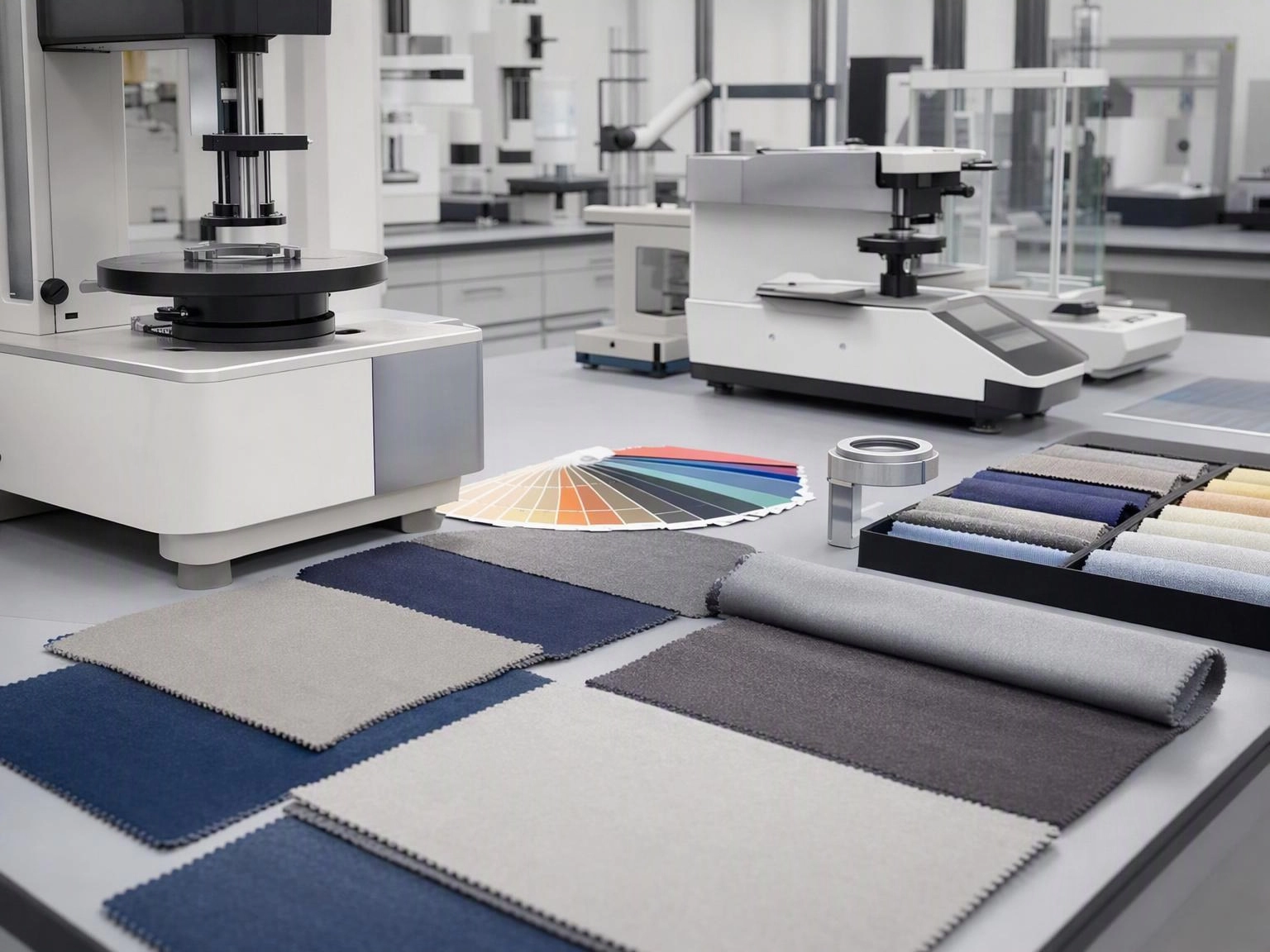
Fabric quality cannot be inspected into a shipment at the port. It has to be measured at the source, batch by batch. A mill with its own laboratory can perform fabric inspection, tensile and tear strength testing, Martindale abrasion, yarn count verification, colourfastness to rubbing and shrinkage testing before goods leave the facility.
That capability shortens the feedback loop dramatically. When a parameter drifts, it can be corrected in the dyeing or finishing stage rather than discovered as a customer complaint weeks later.
Fuxin Textile's Quality Control
Guangdong Fuxin Textile Technology Co., Ltd. operates an integrated quality control system from raw material selection through to final inspection. Every batch of shirting undergoes fabric inspection, colourfastness, breaking strength, shrinkage and pilling checks in our own laboratory, and we can issue the corresponding test reports for tender and acceptance purposes. Where a project specifies particular technical parameters, we develop and verify the fabric against them before bulk production. Send us your quality requirements and we will confirm the achievable targets and provide supporting data.