A Uniform That Works 20 Hours a Day
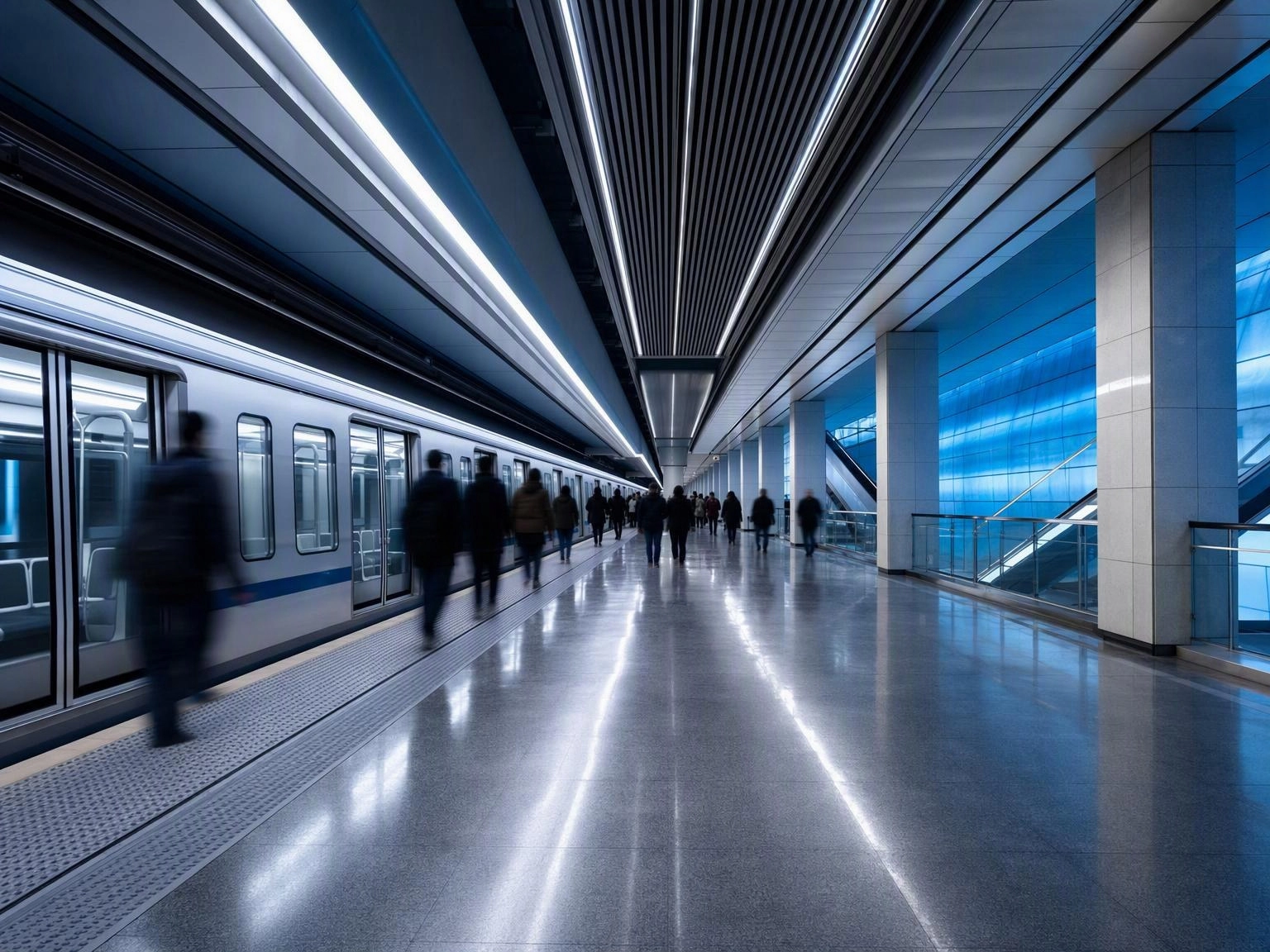
Rail, metro and bus staff wear the same shirt through long shifts, in crowds, across temperature changes, and in continuous contact with seats, handrails and equipment. Their uniforms are usually laundered on a demanding schedule. Fabric that looks correct in a sample book can fail quickly in this environment, and the failures are predictable if you know what to test for.
What Makes Transport Uniforms Different
- Long duty periods. A twelve-hour shift in a warm carriage places sustained demands on moisture management and odour control.
- High abrasion. Constant contact with seats, straps, ticket machines and luggage accelerates wear at cuffs, elbows and shoulders.
- Visible public presence. Colour and shape consistency across a large workforce is part of the operator's brand.
- Frequent industrial laundering. Colour retention and shrinkage control become operational issues, not aesthetic ones.
- Large size curves. A grading error introduced by shrinkage affects thousands of garments at once.
Fabric Requirements Checklist
| Requirement | Target | Why |
|---|---|---|
| Colourfastness to washing | Grade 4 minimum | Uniform appearance across a large fleet |
| Colourfastness to rubbing | Grade 4 minimum | Contact with seats and equipment |
| Colourfastness to light | Grade 4 minimum | Platform and outdoor exposure |
| Residual shrinkage | Within ±2% warp and weft | Size curve integrity |
| Tear strength | High | Resistance to snagging and stress at seams |
| Martindale abrasion | High cycle count | Service life at high-friction areas |
| Air permeability | Moderate to high | Comfort in crowded carriages |
| Moisture management | Wicking finish | Long shifts in warm conditions |
Choosing the Base Construction
For transport shirting, a moderate-count yarn in a twill or plain weave with a poly-cotton or cotton-rich blend is the usual starting point. Twill provides more opacity and better shape retention than plain weave, and it hides soiling more effectively — a practical consideration on a dark uniform worn daily.
Keep the fabric weight in the middle range. Very light fabric clings and loses structure; very heavy fabric is uncomfortable in carriages and slows drying after laundering. Roughly 120 to 150 grams per square metre suits most transport applications.
Colour considerations
Deep navy, charcoal and black dominate transport livery for good reason, but these are also the hardest shades to keep consistent. When specifying deep colours:
- Insist on colourfastness data for washing, rubbing and light separately.
- Request a batch colour tolerance standard, ideally measured instrumentally rather than by eye.
- Confirm that the dyeing route includes adequate soaping and fixation.
- Ask how the mill handles repeat orders — colour consistency between the initial delivery and a replenishment eighteen months later is a common failure point.
Functional Finishes Worth Considering
- Easy-care finishing reduces pressing effort and helps shirts hold a presentable appearance through a long shift.
- Moisture-wicking finishing improves comfort where staff move between conditioned and unconditioned spaces.
- Antibacterial treatment supports odour control over twelve-hour duty periods.
- Anti-static finishing is worth evaluating for technical and maintenance roles.
- Soil-release finishing helps in roles with exposure to grease and particulates.
Each finish adds cost. For most operators, easy-care plus moisture management delivers the strongest return, with antibacterial treatment the next most valuable addition.
Design Details That Extend Fabric Life
The best fabric still fails if the garment design works against it. Practical measures include:
- Reinforced and bar-tacked stress points at pocket corners, plackets and side vents.
- Slightly deeper armholes and a generous back yoke to reduce tension at the shoulder.
- Two-piece collars with fused interlining that holds shape but is not so stiff it cracks.
- Seam finishes appropriate to the fabric weight, with adequate seam allowance.
Managing a Large Rollout
- Confirm the size curve against actual staff measurements rather than assumed distributions.
- Seal both a fabric sample and a finished garment sample from the first production run.
- Wash-test finished garments before full distribution.
- Distribute care instructions and confirm the operator's laundering arrangements.
- Track complaints in the first six months — this is where colour and shrinkage issues surface.
Fuxin Textile for Transport Programs
Guangdong Fuxin Textile Technology Co., Ltd. supplies woven shirting for transport and institutional uniform programs, including metro, rail and bus service. Our fabrics are developed for colourfastness, structure retention under repeated laundering and long-shift comfort, and we provide batch-level test reports to support tender submissions. Share your technical specification and our team will propose a construction and finishing route with samples for wear testing.